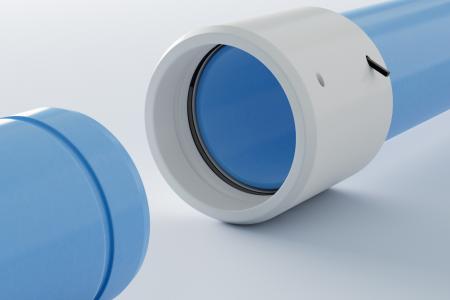
The design process began in January 2006 and by August, Reyes Construction’s 20-person crew was ready to break ground on the project. After excavating the trench, the team disconnected and removed the corroded steel pipe. Reyes Construction team then assembled and installed a new pipeline with Westlake C900/RJ Certa-Lok and regular C900 PVC pipe. The cartridge-style assembly of the 20-foot lengths of Certa-Lok pipe simplified the process and took up less space than welded steel pipes.
“If you lay all steel pipe, you have to do it all in one shot,” says Joe Flores, project manager for Reyes Construction. “We were jumping around, putting PVC and ductile iron fittings in. There’s no way you could do a continuous run like that.”
Ductile iron fittings had to be used at many of the changes in direction creating the need for cathodic protection via an Impressed Current Cathodic Protection (ICCP) system, which is commonly used at large facilities with corrosion problems. The ICCP systems usually consist of a network of DC-powered cathodic protection rectifier stations where the above-ground rectifier module is connected to the pipeline through electrodes welded to ductile iron fittings. Also, connected to the pipeline are bags with metal rod anodes to complete the cathodic protection system. Half of the anodes installed at Point Mugu were magnesium and half were zinc with anode selection depending on the soil conditions. These systems slow the rate of corrosion and keep track of when fittings have corroded to the point of needing replacement.
The most challenging part of the project for Reyes Construction was setting up these individual cathodic test stations, a very time-consuming part of the project. With a station needed at each ductile iron fitting, the total exceeded 300. Ductile iron fittings had to be used at valves and for T-shaped directional changes, but the crew was able to save time and money by using Westlake Pipe & Fittings C900/RJ Sweeps at all angled directional changes, speeding up the process considerably. C900/RJ Sweeps, available in 22.5-degree, 45-degree and 90-degree angle pieces, can be used in place of ductile iron fittings in municipal pipe installations, and since they are made from PVC, require no cathodic protection.
“With the ductile iron fittings, we’d have to go back to each one, weld electrodes to the fitting, draw lines up, put in anode bags, set up the cathodic protection station and set up a box for the station,” Flores explains. “The PVC sweeps allow you to keep the job moving, for every two of those products, I can save a day on the installation.”
Though the cathodic protection portion of the project proved time-consuming, the job moved along steadily without any major hitches. Reyes Construction and Willdan were both pleased with the outcome and see the many advantages of using the corrosion-resistant restrained-joint PVC pipe and sweeps in corrosive soil conditions, such as those on the Pacific Coast.
“It does save you immensely on time,” Flores says. “Once you try the Certa-Lok PVC Sweeps, get going with them and understand their benefits, it really is a no-brainer decision to use them on a project.”
“I think the use of PVC pipe and fittings is becoming more common in our region these days because of its performance and corrosion resistance,” Leathers says. “There was some reluctance at first to move toward PVC because some people didn't think it would be strong enough in comparison to steel pipe, but the material has proven itself. I think a lot of municipalities and agencies are starting to change their way of thinking about PVC.”